Landscape Photography
Cascading waterfalls and time-worn vistas. These images are the backbone of my landscape photography. In this collection, the emphasis is less on the living environment and more on the interplay of shape, form and light across the landscape.
A canyon carpeted in moss? Check. A roaring ice-cold river? Check. Two frozen feet after poor planning? Priceless. A truly stunning scene in Aotearoa’s scenic Mount Aspiring National Park.
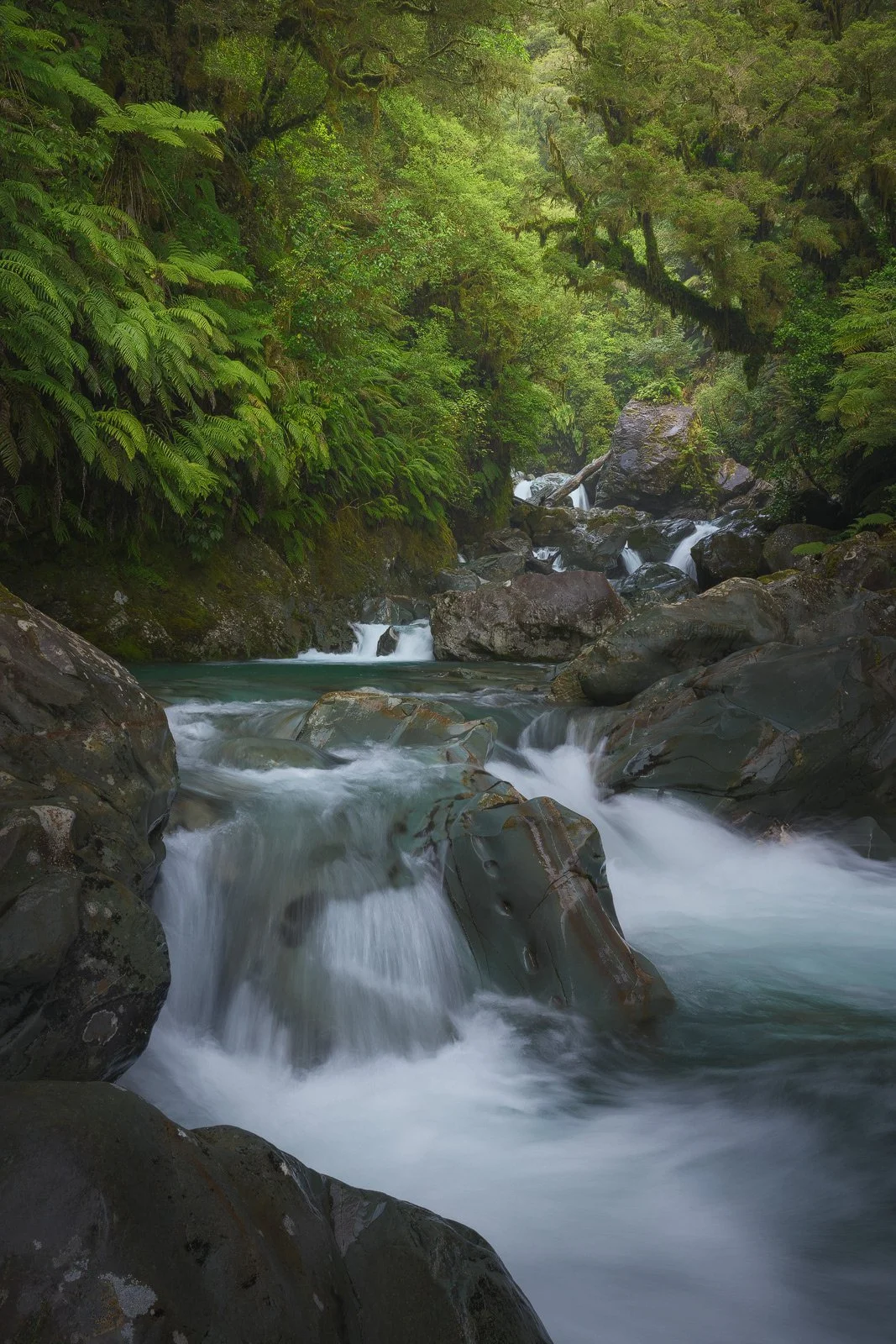
After heavy rain, the crystal clear rivers of Fiordland rise into raging rapids. It’s one of the many moments of awe on offer in this land carved by ice—and still being sculpted with each downpour.
Sweeping sand dunes illuminated on golden hour. Wilsons Promontory National Park is known for its stunning beaches. But the dune of the Big Drift are just as impressive.
One of the many cascades I stumbled upon in New Zealand recently. Fiordland truly is a magical world and a photographer’s playground.
With waterfalls, my first instinct was always to capture the grand scene. To stick with a wide-angle lens and frame a striking stream leading through to the falls as the centrepiece.
Yet I’ve found myself becoming more drawn to smaller scenes within the frame.
They’re not as grand as their wide-angle counterparts. But they do present one of photography’s most rewarding challenges. To distil the essence of an experience into a single, simplified shot.
So on a trip out to The Grampians, I simply took my 70-200mm telephoto on the hike down to the falls. While it was challenging at first, I soon began to notice frames within the falls—focussing on this particular cascade and freezing it at one quarter of a second.
After heavy rains, Fitzroy Falls put on a show, looking more at home in Iceland than Australia’s Southern Highlands. This mighty waterfall is a sight to behold and photograph.
When photographing waterfalls, it’s tempting to use a wide-angle lens and include the entirety of the falls. But often, there are equally impressive hidden gems, waiting to be isolated and captured.
So on a trip out to The Grampians, I simply took my 70-200mm telephoto on the hike down to the falls. While it was challenging at first, I soon began to notice frames within the falls—focussing on this particular cascade and freezing it at one quarter of a second.
With a howling easterly blasting through, it sculpted these shifting sands—forming corrugated waves and peaks several stories high. I stumbled on this sculpted trio nestled beside a larger dune that offered partial respite from the tempest. I ducked down, kept the tripod low and snapped a few frames before the sun dipped out of sight.
On my last day in Tasmania, I stopped by the banks of the South Esk River. After recent rains, tannins from the bush leaked out and created these infinitely interesting swirls. I was mesmerised and snapped off a few frames before heading home.
A moment of morning calm as the rising sun breaks through Fiordland’s ancient beech tree forest.

The hike up to Mount Abrupt offers some of the most scenic mountain views in all of Victoria. (And even more so in the pre-dawn glow.) The pastel sunrise bathed the rugged peaks of The Grampians in light, with Signal Peak standing strong in the distance.